Monday, May 15, 2017

From Port Hardy to Prince Rupert

Our northern adventure begins... on the Northern Adventure
We were in line over two hours early for the ferry from Port Hardy to Prince Rupert.  A little after four that evening, under a heavy rain and chilling winds, the crew began directing and loading us. 

We have been on many ferries, but this one was the first that required all vehicles to be backed into place.  For those not skilled enough or comfortable with backing into such tight quarters, staff members would take the wheel for you and back your vehicle into place.  It took two hours to load everyone, including cars, trucks, motor homes, vehicles pulling trailers, and tractor-trailer rigs.

We were happy and grateful to settle into our little cabin for the night.  Although tiny in size, it had room for four bunk beds, a small desk, and a wet bath, including a hot shower.  It even had a window for views of passing glaciers and waterfalls.  Although the ferry often rocked under strong waves, and the engine literally vibrated the beds, after days of camping in the wet and cold, we felt like we were in a five-star hotel. 

Our cabin aboard the Northern Adventure
The bath, complete with shower 
The view from our cabin window
The lounge area of the ferry was filled with passengers when we went to bed.  Many had staked out their claims, crawling into sleeping bags and sleeping on the floor or finding seats next to the windows.  The lounge seating was much like a large airplane with more room between the seats.  Each seat reclined a little for those wishing to snooze or relax.  The ferry had a television, a play area for children, and a cafeteria.

The ferry ride from Port Hardy to Prince Rupert is a 22-hour ferry run with two stops along the way.  When we awoke and arrived on deck, we were surprised to find a lot fewer folks on board.  Evidently many had departed when we ported in Bella Bella.  With coffee in hand, we strolled the lounge deck, watching the scenery.  Unfortunately the skies remained gray all day.  Still, the views on the inside passage were lovely.


 After talking with several dog owners, we were glad that Roxanne did not need to endure the 22-hour ferry ride alone in the vehicle deck.  Fellow Texans had brought their two Dachshunds.  The couple was allowed to take several 15-minute trips down to their vehicle to walk the dogs on the deck.  (One stop was at 1:00 am when we docked in Bella Bella.  The other was around 9:00 am.)  Crew members hosed the deck down after the dogs did their bathroom duties.  However, with all the engine noise, movement, and darkness, the little Dachshunds were quite traumatized by the experience.  Another gentleman who often took the ferry said, however, that his dog had no problem with the ride.

We arrived in Prince Rupert around four in the afternoon.  A whale was spotted in the harbor as we arrived.  While it was too far away to get a good photo, we were delighted to see it and took it as a good omen.

Prince Rupert
We debarked and drove into town for a bite to eat.  We needed to be back at the ferry terminal by eight o’clock that evening for our sail to Haida Gwaii.  It began raining in earnest as everyone backed their vehicles into place. Loading the ferry ran late because of the weather, and it was nearly eleven before we finally got underway.  I was so grateful that David had reserved another cabin for us.  They were completely sold out of rooms when we arrived.  We were so tired that all we could do was fall into bed to sleep.

The purser woke everyone around 4:30 the next morning, announcing that we would dock within the half hour.  Although we were still tired, we were delighted to see sunshine beginning to peak above the horizon.  Haida Gwaii… here we come!

Saturday, May 13, 2017

Vancouver Island

All aboard the ferry to Victoria on Vancouver Island
We left Samammish and crossed the Canadian border, arriving at the Tswwassen-Swartz Bay ferry port.  We had a five o’clock sail that docked us in Victoria a little after seven that evening.  Although still chilly, the skies were blue with billowy clouds.  We were grateful for the sunshine.

David managed to locate a campground about a half hour from the ferry terminal.  To say the least, we were tired.  We took a short stroll down to the water, then crawled into the camper for a good night’s sleep.

On the advice of a friend, the next morning we decided to visit Victoria’s famed Butchart Gardens.  We were so glad we did!  Once an old limestone quarry, Mrs. Butchart decided to transform it into a multi-level garden.  The Butchart family spent years remaking it into the stunning landscape it is today.  Engulfed in spring’s bounty, the grounds were blanketed with blooming tulips, azaleas, rhododendrons, as well as other amazing flowers. 


 We arrived before the gardens opened and were among the first to enter.  The tour buses began rolling in around ten.  By eleven, we had made the rounds and even grabbed a bite to eat at the Blue Poppy Café.

From Victoria, we headed north.  Our plans were to spend four days traveling the length of Vancouver Island, seeing as much as we could see.  We drove to Port Renfrew on the western shore, finding a First Nation campground right on the beach.  Rain and a damp chill in the air drove us into the camper early.

Thankfully, we awoke to spotted sunshine.  We drove to Sombrio beach and hiked about a half mile down to the ocean, through a spectacular forest of very large cedar, maple, and hemlock.  Like much of the upper west coast in the U.S., these shores are well below the cliffs.  A lady at the visitor center said we could see tidal pools on this beach.  We hiked across the rocky shoreline to a promising set of boulders, but, alas, no sea stars or anemones.  Nonetheless, the beach was lovely.

Sombrero beach, Vancouver
From the beach, we drove just outside Port Renfrew to Avatar Grove, a fairly recently discovered old growth forest and home to Canada’s gnarliest tree.  The hike was fairly short but strenuous with all the ups and downs.  The gnarly tree was amazing.

Entrance to Avatar Grove
Avatar Grove, Vancouver
A couple climbs the steep stairs at Avatar Grove 
Canada's gnarliest tree
We drove back to the east side of the island and spent the night at Rathtrevor beach and its lovely provincial park (complete with hot showers!).  Rains began in earnest that evening and lasted through most of the next day.  Undaunted, we strolled through another old growth forest named Cathedral Grove. 

Entrance to Cathedral Grove trail
Cathedral Grove 
Cathedral Grove
We drove Coastal Road 19A as long as we could, encountering quaint beach towns as well as worn and weathered way stations along the way.  When the road ended, we turned north and drove deep into Strathcona Provincial Park, the largest park on the island.  We spent the night at the Ralph Lake campground, an inlet on Buttle Lake, the largest lake in the park. 

Ralph Lake campground
We had a short respite from the rain that afternoon, but it began again by evening.  Thankfully, we awoke to mostly sunny skies.  Our campsite was near a short path to the beach.  We took the stroll and found a family of geese with tiny goslings in tow paddling across the lake in the bright morning sun.


We had one more night on Vancouver island before boarding the ferry to Prince Rupert.  While scouring the map, David located a small, remote campground in Schoen Lake Provincial Park.  It took us nearly a half hour to drive the 11 miles of rocky road into the campground.  We were surprised to find that we were the only campers there. 


What a beautiful, quiet, and peaceful place it was!  We sat by the pristine lake in the fading sun as long as we could before gray skies, misty rain, and a damp, cold breeze drove us into the camper.  Unfortunately the photo doesn't do the site justice... just too many clouds to see the snow-capped Schoen mountain in the background.

We awoke to a chilly 39 degrees.  As we left the park, we startled a black bear.  He literally turned tail and ran right across the road in front of us.  Shortly up the road, we saw eight deer bolt up the mountainside. 

With only a short drive left to Port Hardy, we made a side trip to Sayward, another seaside town.  Looking for a café, we drove down to the dock and discovered a huge logging operation.  Logs were trucked to the facility, sorted, and bundled by huge machinery capable of lifting 60,000 pounds.  The bundled logs were then rolled into the harbor.  We watched skilled captains maneuver their agile boom boats, moving escaped logs and sorted bundles into booms for shipping to sawmills and sea vessels.  David took a few videos of the process…


Logging is one of Vancouver’s main industries.  Many mountains here are zigzagged with scars from clear cutting.  The tree farms are then replanted to grow again.  We quickly learned that most dangerous vehicles on the road here are loaded logging trucks.  Some of these truckers seem hell bent on driving as fast as possible, taking their half out of the middle of winding roads.  It is always judicious to run your vehicle as close to the outer edge of your lane as possible.


We re-provisioned in Port McNeil then drove into Port Hardy.  We needed to arrive at the ferry terminal by 4:00 pm for our 22-hour sail to Prince Rupert.  Hopefully we’ll be able to post this before boarding a second ferry to Skidegate on Haida Gwaii (formerly Queen Charlotte Island).  Our journey through the inside
passage begins!

Sunday, May 7, 2017

Wild horses... one more time...

Davis Mountains, Utah
With the truck repaired, we decided to say goodbye to our Utah wild horse herd before turning north to Washington.  This is the earliest in the year we have ever traveled to wild horse areas.  The best part has been seeing the new foals.


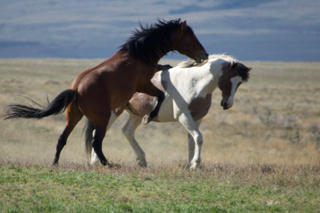
And, of course, the stallions having their tiffs...


After a short adieu, we left Utah.  We traveled across Nevada then turned north into Oregon.  A friend suggested we visit the Steens Mountains wild horse herd.  Unfortunately with 89 inches of snow still needing to melt, the wild horse loop was closed.  We did, however, find a BLM brochure on the Kiger mustang herd and decided to try to locate them the following morning.

The road was rugged and wet... definitely one best traveled in a vehicle with high clearance.  It took us nearly an hour to travel eleven miles to the viewing area.


We finally found the viewing lot.  The scenery was beautiful... but no horses.  Finally, as if to appease us, a lone horse walked into the valley below us, out from among the junipers.  We watched for a while, hoping others would join him.  Unfortunately, no.  We needed to get back on the road to visit our friends in Washington, so we made the trek back towards Burns.

Kiger mustang signpost

Steen Mountains
Lone Kiger mustang
Along with a BLM brochure on the Kiger mustangs, we had also discovered a brochure on a BLM wild horse holding corral.  David mapped the directions to the Hines corrals and found they were practically on our route.  We decided to see if they would allow us in to view the corrals and horses.

This past year's journey through wild horse country has been more than just a little surprising... and a great education.  Originally we had just wanted to visit as many wild horse herds as we could.  We never expected to encounter the emotionally-charged controversy surrounding these amazing creatures.  Over the past year, we have learned much.  We have spoken with many members of wild horse advocacy groups, some cooperative and others hostile to the BLM.  We had only spoken with one BLM official.

As we've reported, much of the controversy lies with the 45,000 once wild horses now living in corrals managed by the BLM.  We had heard horror stories ranging from overcrowding to malnutrition to outright abuse.  We felt that in order to get a full view of both sides of the issue we should try to see the BLM's perspective and visit at least one of their corrals.

We didn't know what to expect when we went to the BLM office and asked if we could see the corrals.  To our surprise, not only were we allowed on the premises, the facility's personnel welcomed us.  They even had an auto tour around the corrals for the public to view the horses and how they are kept.

Quite honestly, it is an amazing facility.  The over 500 horses living there were segregated into logical corrals:  mares with foals, weanlings with yearlings, and, of course, corrals for geldings.  There was no overcrowding, and the horses were obviously calm and well fed.  Most importantly, each corral was immaculately clean... a telltale sign of good care to anyone with ranching experience.

Mare and foal corral in foreground
Gelding pen
Plenty of fresh hay
New hay barn
We spoke with two ladies in the facility's office.  One was the manager of the corrals.  She had started with the BLM as a wrangler and worked her way up to become facility manager.  Her passion for saving these horses was evident and equal to those we had met in the various advocacy groups.  She had adopted two wild horses.  One she had recently lost due to a heart aneurism.  I recognized the pain in her eyes as she told us about losing her beloved horse... it was the same as I feel when I speak of losing our Roxanne.

Is the Hines wild horse corral facility simply a model while other BLM holding corrals pale in comparison?  If so, it is a very good model, indeed.  While some other BLM facilities may have diminished adoption rates, the Hines facility does not.  They promote their horses for adoption.  I was tremendously impressed.

We leave the wild horses for this leg of our trip and turn our sights now to Alaska.  We know full well that the controversy surrounding these amazing animals will continue.  We are buoyed, however, by the fact that we have met so many who are passionate about saving these symbols of the west... both in advocacy groups and BLM personnel.  We also know that there are things each of us can do to help.  (For more information, see our September 20, 2016 post What you can do to help.)

Tonight we are in Sammamish, Washington, visiting dear friends.  I am happy to report that the camera appears to be functioning well again.  As suspected, it was an operator error.  Thankfully, last night one of our RMOWP  (rmowp.org) friends was able to walk me through the fix over the phone... thanks, Al!

Tomorrow we leave for Vancouver.  Our plans are to drive from Victoria to Port Hardy.  In Port Hardy we board a ferry to Prince Rupert then to Skidegate on Haida Gwaii.  I'm not certain when we'll have internet connection again, but know we will add posts when we can.  Until next time...

Friday, May 5, 2017

The Tribute

Roxanne (2001-2016)

It is a year ago to the day that we lost Roxanne.  Finally, I post a small tribute...

We called her the 98-pound Wonder... the Circus Dog... Roxanne.  She could yodel, hop through hoops, climb ladders, and make a six-foot vertical jump from a sit.  She only retrieved golf balls.  She crossed the Arctic Circle six times, traveled over 500,000 miles with us, and loved the smell of bison and bears.  She thought horses were big dogs but never could figure out what a little dog was.  She hiked hundreds of miles with us and loved to swim in freezing water.  She had the courage of a lion.  She rode in canoes, ferries, hay wagons, and elevators and laid at my feet at conferences, expos, and restaurants.  She was a therapy dog, helping the sick, elderly, and foster youth.  She was a Canine Good Citizen and too smart for her own good.  She was the quintessential Golden, always loving, adaptable, gentle, and happy.  For 14-1/2 years, she brought us love, service, loyalty, and joy...  Our Roxanne  


Monday, May 1, 2017

A Bit of Trouble in Tooele

Pahvant Range near Salina, Arizona
It's been a very interesting beginning to our trip.  While in Sierra Vista, we had several days of 90-degree weather.  Now it's cold... really cold for a couple of Texans.  The highs have been in the 40s and the lows hovering around freezing.  The biting wind makes it feel even colder and has left us scrambling for sweatshirts and even parkas.

Our first night after Sierra Vista, we boondocked north of Salina on national forest land.  Clouds covered the surrounding mountains.  Soon after we pitched camp, it began to snow.  SNOW!  While the accumulation was only about a half inch, it was still a surprise to us.  At home, spring began in early March.  Here most trees are just beginning to bud.  The tulips haven't even flowered yet.

Snowing... big flakes!
We easily made it to my wild horse herd the following day.  I admit, however, that it has been frustrating taking photographs.  More and more folks seem to ignore photography ethics and BLM guidelines.  Rather than keeping a 100-foot distance, they walk among the horses, making it difficult for photographers who follow the rules to get a good shot.  Most disturbing, by walking in such close proximity to the horses, they are habituating them more and more to humans, leaving the horses less and less wild.

In addition, I have a new camera and can't seem to get the focus quite right.  I apologize for the lack of quality.  Hopefully I'll figure this out quickly.

This is the earliest we have ever been to the Davis Mountains.  We have been surprised at the number of sheep and cattle we have encountered grazing on this horse management area.  There are literally thousands and thousands of sheep.  We saw at least a half dozen separate flocks, each herded by dogs and led by men on horseback.  Their camps included large water tanks on flatbeds and sheepherder trailers.

Sheepherder camp
Sheep dog takes a break
The cattle seemed to be a surprise to the horses, too.  We visited one of our favorite wild horse herds at their watering hole.  A herd of cattle began moseying toward them.  As one cow approached the horses, the entire herd looked at her as if she were something they had never seen before.  It was too funny.

Wild horses seem surprised when a cow strolls into the herd.
We were pleased to see that the horses had fared well over the winter.  The mares had begun dropping spring foals.  Young stallions were sparing.  Old stallions limped along, showing their battle scars.

A young foal
Young stallions sparing
Battle scars
Hoping that the other photographers would pack up and go home after the weekend, we decided to drive the 50 miles to Fish Springs National Wildlife Refuge, a marshland oasis in the midst of the desert.  Unfortunately, most of the migratory birds had already left for their nesting grounds.  We did spy a few white pelicans and Canada geese.

Pelicans at Fish Springs National Wildlife Refuge
On our way back to the horses, the truck sputtered and stopped.  The dash showed a variety of lights flashing, indicating an issue.  Hoping it was a fluke, David turned off the engine, restarted, and we began again.  I took the wheel while David looked through the maintenance literature, hoping to find an answer.   The truck lost power again.  Without a doubt, we had an issue.

We limped into Tooele and found a motel near the Ford dealership.  David had the truck in first thing this morning.  We have just received a call from the service manager that the throttle unit has malfunctioned and needs to be replaced.  He has the part in stock and will have the truck fixed by this evening.  We feel blessed... we will be back on the road again tomorrow.  And as an added bonus, we even had hot showers.

Tomorrow morning we'll return to the horses, spending one more night with them before heading to Washington for a short reunion with dear friends.  Life is good!

Thursday, April 27, 2017

Let the Adventure Begin!

Dear Friends,

We are leaving Sierra Vista, Arizona, this morning after a wonderful conference with our RMOWP friends (Rocky Mountain Outdoor Writers and Photographers, rmowp.org).

From here we will visit our wild horse herd in Utah, then head straight to Washington state.  After two nights with former neighbors, we board the Vancouver ferry.  Our hope this year is to ride the BC and Alaska ferry system and island hop our way to Haines, Alaska.  If all works well, we will visit Haida Gwaii in the Queen Charlotte Islands, then take the Alaska ferry from Prince Rupert up the inward passage, with stops at Prince of Wales Island, Petersburg, Ketchikan, and Juneau.  Depending on ferry availability, we will stop at a few other ports.

We have a young friend who will join us for three weeks, beginning in mid-June.  Morgan will meet us in Anchorage.  From there... who knows?  We'll see where the wind takes us!

We invite each of you to join us... let the adventure begin!

Wednesday, September 21, 2016

The White Mountain Wild Horse Herd

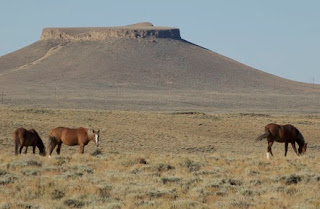
White Mountain wild horses graze in front of Pilot Butte
We arrived in the White Mountains and entered the Wild Horse Loop from Rock Springs, Wyoming.  The road was fairly rough from the Rock Springs entrance but not too rutted for a SUV.  Deep ruts in lower areas of the road did, however, indicate that the road was probably impassable when wet.

The White Mountain Horse Management Area encompasses 392,000 acres and has a planned population of 250 wild horses.  We found these horses to be quite elusive and skittish.   Even at 100 yards, most of the horses would begin to trot away once they saw the truck stop.

Shy White Mountain wild horses trot away at the sight of us.
It was getting pretty late in the afternoon.  With few bands near the roadside, we decided to hike over the ridge on the south side of the road to see if horses might be hiding below it.  Unfortunately, they were not.  The wind, however, was blowing so hard that it was impossible to keep my cap on my head.  We figured it would be best to try to find a protected area to set camp.  We took a dirt road that seemed to lead to a lower area.  Even there, however, the wind was easily gusting 30 to 40 miles per hour.  We tucked our chairs close to the truck, but the dust was blowing too badly.  We finally gave up and dove inside the camper.

Campsite in White Mountains
After the sun set, the winds died down substantially, and we had a restful night, drifting to sleep with a coyote lullabye.  We broke camp the next morning, hoping to find more horses.  A small band grazed near Pilot Butte.  At 7,932 feet, Pilot Butte is the highest point in the White Mountains and was used as a landmark for travelers on the Oregon and Overland Trails.

The closer we drove toward Green River, the better the road became.  In fact, a sedan could easily traverse this section of the road.  As we turned the corner towards the end of the White Mountain Wild Horse Loop, we spied a band of about fifteen horses grazing on the hillside.  While cautious of us, they were definitely less skittish than the other bands we had encountered.  They allowed us to walk within about 30 yards of the band before they started moving away.  I was glad to take at least a couple of closer photographs with the long-range lens.


We planned to stop for breakfast in Green River and determine our next route.  With fall colors beginning to show and the Grand Tetons within a day's drive, we had decided to veer from our wild horse tour to make a stop at one of our favorite national parks.

For more information about the White Mountain wild horses and to learn about their advocacy group, please click here:  https://www.facebook.com/whitemountainwildhorses/