Thursday, August 17, 2023

The Dalton Highway, aka The Haul Road

Camped beneath the Brooks Range on the Dalton Highway, Alaska

The Dalton Highway, affectionately called the Haul Road by truckers, lies north of Fairbanks. It is a road we have traveled often, but it constantly changes, making it new each time. This is a working road. Truckers have the right of way. Tourists are advised not to take the road because of its lack of medical services and ruggedness. We’ve already heard of travelers this trip with broken leaf springs, punctured tires, and a myriad of other mechanical issues. 

The Dalton is 466 miles, mostly gravel, and ending in Prudohe Bay at the edge of the Arctic Ocean. This is where the Alaska pipeline begins. It ends at Valdez. 


Pipeline along the Dalton Highway, Alaska

About a day and a half after we began traveling the Dalton, a fox ran past us, carrying something in its mouth. I handed my camera to David to take a photo since it was on his side of the truck. David immediately noticed that I had not put my memory card back in the camera after my last blog posts. I was sick about it. All those photos of the Brooks Range swirled in beautiful clouds were gone. What is a girl to do? Simply carry on. (Most of the photos shown are from our smartphones.)


Traveling the famous Atigun Pass on the Dalton Highway


We have traveled the Dalton and seen many animals. Other times we have seen none. This was one of those times. We were unaware that bow season for caribou had started just days before our arrival. We saw hundreds of hunters lining the roadway. 


Hunters are welcome to hunt with bows along the road. (Those using firearms must hike a minimum of five miles from the pipeline.) And we saw literally hundreds of hunters strategically positioned along the roadside, camping in tents on the tundra. Unfortunately, they drove all wildlife away. 


We stopped at the Arctic Circle and took photos of Sam on her first crossing. 


Sam during her first Arctic Circle crossing

By the time we hit Prudohe Bay, it was cold with misty rain.  The area surrounding Prudohe Bay is basically marsh and lowland.  It sits on the Arctic Ocean, but, because of security reasons, tourists must take a bus to see the ocean up close and personal.


Prudohe Bay, Alaska

Marsh and lowland surrounding Prudohe Bay

We did spy a few musk ox near the bluffs, but they were too far away to get a good photo.


Musk ox in the distance


When we awoke the next morning, the temperature was 37 degrees. We quickly found our cold weather gear and lamented that our friends and family at home were dealing with their 37th day of 100+ degree weather. Wish we could send some of this cold air their way!


We camped near Atigun Pass, taking Sam for walks in between rain showers. We wrestled with staying an extra day, hoping to find the musk ox herd.  But with all the hunters, the chances of seeing more wildlife was limited. 


We did see a lone caribou in the distance during the trip back down. With all the hunters, however, I’m not certain he has a chance. 


So we said goodbye to the Haul Road… until we meet again. 


Sam, David, and me at the end of the Dalton Highway


Saturday, August 12, 2023

Denali Found

Denali Mountain, Alaska

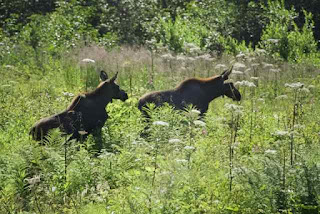
 We continued our travel along Denali 8. We spied two moose cows grazing, then a pair of swans with their lone cygnet. 


Only thirty percent of visitors to Denali actually see the mountain. We have been here when we couldn’t see a thing because the mountain was shrouded in clouds. We have also seen Denali in all its glory. 


We arrived at Denali in rain. To our dismay, all the park campgrounds were full. Private vehicles are only allowed to drive the first fifteen miles into Denali. Beyond the bridge, visitors must take a park bus. 


We have seen many animals, mostly moose and caribou, along this fifteen-mile route in the past. Not today. Denali mountain was also hidden behind clouds. 


We found a place to boondock about thirty minutes outside the park. The next morning, we were back, taking the fifteen-mile road again. We spied several of the park buses along the road. It normally means they have spied something worth seeing. 


And there it was, Denali mountain peeking through the clouds. It is a view I never tire of seeing. After taking a few photos, we continued our search for animals. Again, there were none to be found. 


We figured folks on the tour buses deep into the park would see many creatures. In the past, we have seen wolves play, bears, sheep, moose, caribou, and all kinds of other varmints while traveling on the bus. But after questioning several, they had seen only a few animals on their bus rides. 


It is too early in the season for rut. The weather was in the 60s and too warm to drive the animals down from the high country. There was no hope of gaining a campsite within the park with the weekend around the corner. And heavy rain was in the forecast… we made an executive decision to leave Denali for another time. Adios, beautiful mountain. 


Friday, August 11, 2023

How a Simple Morning Changed Me

A Rare Fog Bow on Denali 8, Alaska

(Warning:  Waxing Rhapsodic)


I admit that I get so focused on photographing animals sometimes that I fail to notice little else. Here we are, seeing all these wondrous landscapes and places, searching every bend for something new, but I’m still hungering for more animals. Then I wake up to a dreary morning after a night of rain with fog so thick we can’t see ten feet in front of us. And I figure it will be a miracle if we can identify a creature, even if it plants itself on the road directly in front of us. 


Then God laughs and tells me I have no idea what He can do. I can almost hear His gentle chuckle. 


We watched the sun struggle through the fog, giving the camp an eerie glow. Waves of clouds rolled over us, sometimes extremely heavy and dense. Temperatures were in the low 40s, and the damp air penetrated our sweatshirts. 


Camp in dense fog, Denali 8, Alaska


Sam, thankful to be out of the truck, climbed the sand hill we were camped next to, looking almost regal. Then, of course, she returned to her silly self, playing (what we affectionately call) wacko dog.  


A brief respite from the dense fog… then another cloud rolled over us. We guessed that the density of the fog was due to clouds coming off the nearby glacier. 


Another wave of dense fog


Then, there it was, a white rainbow arched across the horizon. I had never seen anything like it. It was a perfect arch and undeniably a rainbow, but completely colorless. 


As soon as we reached cell service, I looked it up. I learned that it was actually a fogbow, an incredibly rare and extraordinary phenomenon caused by dense fog and sunlight. 


The website earthsky.org explains them, “Fogbows also go by the names white rainbow, cloudbow or ghost rainbow. They’re made much as rainbows are, from the same configuration of sunlight and moisture. Rainbows happen when the raindrops fill the air. You always see a rainbow in the direction opposite the sun. Fogbows are much the same, always opposite the sun. But the small droplets inside a fog or cloud create fogbows as compared to larger raindrops that create rainbows… Because the water droplets in fog are so small, fogbows have only weak colors or are colorless.”


So we marveled at the sight. We took photos and panoramics. Quite honestly, I haven’t felt this awed since we saw the northern lights for the first time. 


How great Thou art, Dear Lord… to take a simple foggy morning and turn it into something beyond spectacular. You are, indeed, absolutely amazing. Thank you. 


My shadow under the incredible Fog Bow


Wednesday, August 9, 2023

Valdez Revisited

Rainy morning on Prince William Sound, Alaska

We arrived in Valdez to find only a few salmon had arrived. We soon learned that the salmon counts were down substantially. This return trip may have been a boondoggle. 

We saw no bears at our normal site. The weir, however, had become even more chaotic. The gulls now numbered in the tens of thousands. Sea lions still gobbled. Sam was still stuck in the truck.  


Tens of thousands of gulls in Valdez, Alaska


We stayed for two nights. The second morning we spied a brown bear and her cub on the flats near No Name Creek. While they were not close enough for a great photo, it was a blessing to see them and watch them interact. 

Brown bear and her cub, Valdez, Alaska


We spent the night in a campground for showers and Wi-Fi. It began to rain around three, and rained steadily throughout the night. 


We had met a fellow putting out posters for his lost eight-year-old beagle earlier in the day.  He and his wife had been looking for their dog for four days.  She had been spotted but fled whenever someone tried to catch her.  I don't know if he ever found her.  It is one of the open-ended stories that we often hear while on the road.


On our last morning, we spied a wayward swan in Prince William Sound. It may have been a rare Mute swan… perhaps someone can identify it for me. How blessed we are. 


Swan on Prince William Sound


I’m sad that our normal number of bears were not here and am hoping that the salmon are just late and their numbers continue to be strong. We remain, however, happy to have been here. 


We leave Valdez to connect with Denali 8, a favorite road. Let’s see what happens next!


Monday, August 7, 2023

Hopeful in Hope


One of the things David and I enjoy most about our trips is observing and photographing wildlife in their natural habitats. I’m particularly fond of bears and wild horses. David enjoys hoofed animals, bears, and birds. With Alaska having most of these creatures in abundance, it makes for an especially rich experience for us. It also keeps us on the move. 

Since we spent much less time in Homer than expected, we wondered if revisiting Valdez might give us the opportunity to photograph those elusive bears. A quick call to the forest rangers in Valdez confirmed that the wild salmon had begun arriving. We made a rash decision to retrace our route back to Valdez. The detour would also allow us to travel Denali 8, another favorite route. 


Our goal is to visit Denali, the Dalton Highway, and the Dempster Highway before beginning our journey south. However, we want to visit the Dalton and Dempster no earlier than mid or end of August when most creatures will be foraging in earnest in preparation for winter and, as a result, are more visible. 


We returned to Skilak to camp, then took a detour through Hope, Alaska. Hope is an old mining town settled during the 1895 gold rush. It sits along the west side of Turnagain Arm.  Several of the original buildings still remain. 


Hope, Alaska

Hope, Alaska


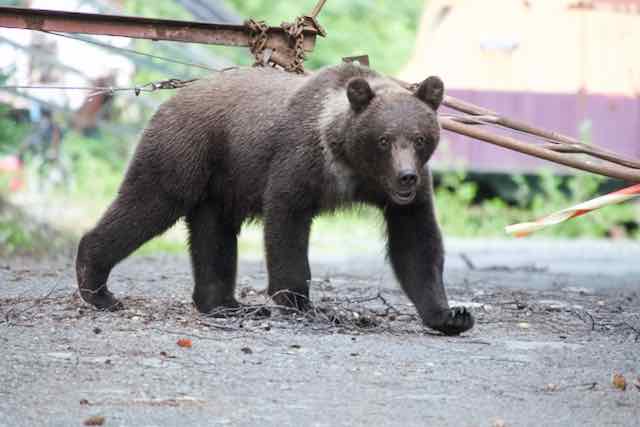
As we left Hope, we spied a young brown bear crossing the road. Although the backdrop is a construction site, she still looked wonderful to me. 


While at the Hope Campground, we took a hike. To our dismay, Sam rolled in some unidentifiable scat left by some large mammal. I also noticed that every evening I smelled dead fish. At first I thought I hadn’t tossed the garbage. Then I realized the smell was most evident when Sam was around.  She had rolled on a fish carcass and seaweed in Anchor Point. Quite honestly, Sam was becoming quite rank. We knew it was time to find a dog wash. Thankfully, we found one in Anchorage. 


Ah, the joys and of traveling with Sam. Back to Valdez. 


Saturday, August 5, 2023

Homer and Beyond


David and Sam on Anchor Point Beach, Alaska.  Mount Iliamna in background.

Traffic was more than we remembered on our trek through Anchorage, Soldotna, and on to the Kenai Peninsula. Whenever we’re in remote places, coming back into cities can feel overwhelming.   We camped at Skilak Lake, one of our favorite places. The number of fisher folks, however, was crazy, and the campground nearly full. 

We did spy a little black bear on the gravel road to the lake. We soon also discovered that a fire had raged through the area several years ago, making it almost unrecognizable. With all the traffic and changes, we decided to head on to Homer. 


A fellow photographer had told us to stop by Deep Creek to check out the eagles. Unfortunately, we found only seagulls. So we drove on.  


Homer is a seaside town resting on Kachemak Bay. We have been here several times before, but not in over five years. We were amazed at the growth, making this quaint seaside town more of a tourist destination. It had at least doubled in size. Tourism had also grown exponentially. The last time we visited, the end of the Spit (the thread of land connecting Homer to the sea) was the end of the road and a lookout point over the bay. Now a hotel sat at the end of this strip of land. 


Traffic was at a crawl and bumper to bumper. Shops and parking lots to serve tourists had sprung up on every smidgeon of available land. Hundreds of RVs were crammed in gravel pit campsites. We felt crushed on every side. 


We left town quickly and camped at a familiar spot, Anchor Point. It was a breath of fresh air. We went down to the beach and watched several boats being transported to the water.  In a unique operation, they use a large front-end loader (often used in construction) modified with a boat trailer hitch capable of hauling and launching big fishing boats.  They back the boat into sufficiently deep water to launch it.  Once the boat floats off the trailer, the captain reverses the engines to head into deeper waters.


Boat launch at Anchor Point, Alaska

We watched a group horseback ride the beach.


Horseback riders, Anchor Point, Alaska

On the way to our campsite, we spied a mother moose and her twin calves.


Moose cow near Anchor Point, Alaska

Twin moose calves, near Anchor Point, Alaska

Later we met Bill, a lone Englishman traveling the Kenai. We camped next to Bill and had him over for a cup of wine (since we had already eaten supper). He told us a bit about his life. He lived outside Manchester, was a retired civil engineer, and a world traveler. Traveling was his passion. He had no family, so he spent his time traveling with only a backpack and his wits. He spoke of traveling to Madagascar and the Canary Islands and the Sudan and everywhere in between. Bill even told us about hiking Skagway’s historic and grueling 33-mile Chilkoot gold rush trail in June with no snowshoes. As Bill said, “And I really needed snowshoes!”


A piece of me envies Bill’s travels, but I feel blessed to have my traveling companion. It must get lonely traveling so far from home all alone. As Bill lamented, at his age most of his traveling buddies are gone or no longer able to travel with him, and he no longer has the stamina for longer treks. 


Bill carried no technology with him… no phone, no computer. He hitchhiked or took busses or trains or relied on newly-met friends to ferry him to his next destination. 


We took him to his next bus ride this morning. David lifted Bill’s 60-to-65-pound pack from our camper, and Bill strapped it on his shoulders. We said our goodbyes at a fittingly named bus stop and restaurant for a traveling Brit… the Cheeky Moose. 


David and Bill in front of the Cheeky Moose

We decided to leave the Kenai and it’s hustle and bustle. On our way out, we stopped by the old Ninilchik Russian Orthodox Church. The 1901 church replaced one built in 1846. It’s unique design is in the shape of a cross. Its gable roof is crowned by an octagonal cupola and five onion domes.  The surrounding cemetery is laced with orthodox crosses and daisies.  Set upon a bluff overlooking the bay, the Iliamna volcano can be seen from the church yard. 


Ninilchik Russian Orthodox Church, Alaska

Crosses and Daisies at Ninilchik Russian Orthodox Church, Alaska

As we made our way back to the truck, I could hardly believe it when I spied an eagle standing guard over her nest. Amazing!  Later, we caught a glimpse of a bear on the road back to Skilak. While not great photos, it is still a blessing to see these creatures. 


Eagle guarding nest, Ninilchik, Alaska

Shy bear, Skilak Lake, Alaska

We have made record time traveling the Kenai Peninsula.  As we look at the map and timing, we have come to an interesting conclusion. Perhaps another visit to Valdez IS in our near future. I am smiling.