Showing posts with label wild horses of idaho. Show all posts

Monday, September 7, 2020

Heat, Haze, and a Horse of a Different Color


We arrived at the Black Mountain Wild Horse Management area late afternoon.  We drove the entrance road to the exit, but found no horses.  Unfortunately, we did find several trucks parked with empty ATV ramps.  In our experience, wild horses flee whenever they hear an ATV because they have been chased by them so often.

We found a side road and drove it until we found a place to camp.  The Black Mountains are lovely but have one tremendous disadvantage... black flies.  They were so relentless that we decided to call it the Black Fly HMA instead of Black Mountain.

We strolled up a ridge.  With binoculars, we were delighted to find a large band of wild horses in the distance.


Perhaps they would still be in the vicinity next morning.  Then we heard an ATV.  By the time we made it back to camp, the fellow driving the ATV raced past us, up the same trail we had just come down, leaving us in a cloud of dust.  After about a half hour, he raced back down, then turned up another road.  So much for seeing any wild horses, I thought.  But then, again, God always surprises me.

The sun was beginning to set when I saw movement out of the corner of my eye.  Incredibly, a lone stallion was walking over the hill towards us.  He walked slowly, and when he finally recognized we were in front of him, he simply made a wider berth around us before disappearing over a hill on the opposite side of the road.  The stallion looked worn, with all kinds of scars on his girth and haunches and a ratty-looking tail.  This horse had definitely seen some battles during his lifetime.  Perhaps he was just old, tired, and unafraid of ATVs.


Sunset was beautiful, followed by that gorgeous full moon.


The next morning, we broke camp, hoping to find the band of horses on the hill.  They were, indeed, closer to the road, so we drove the truck as close to them as we could, then set out on foot.  They were most uncooperative, moving several feet away from us with every step we took.  We finally had to settle for photos in shade and at a distance.


Among the band was a colt with the most odd colorings I have ever seen.  His mane was dark, matching his coat.  His tail was short and blonde.  And he had different length white socks on all four feet.  He was most definitely the "horse of a different color" you've heard tell about.  


The Black Mountain wild horses are few in number, with a population of only 60 horses.  They are believed to be descendants of Calvary re-mounts.  Their HMA is rather large and includes 50,904 acres.  

It was still early morning.  With all the ATV activity in the area, we figured we had seen all the horses we could and decided to go to one last Idaho wild horse area near Glenn's Ferry.  

The Saylor Creek HMA proved to be difficult to locate.  We asked for directions in town, then called the Bureau of Land Management (BLM) office, and, finally, received help from a most unexpected source.  We were at a cross roads, traveling the directions given to us by the BLM manager.  As we tried to decide if we should go left or straight, a gentleman in the neighboring mint field jumped off his enormous tractor with its disking harrow and asked if he could help.

We told him we were looking for the wild horses.  He was able to provide us with exact directions.  He cautioned, however, that he had not seen the horses in several years.  An enormous brush fire had broken out and driven the horses deep into BLM ground.  We then chatted about the farming area he was working.  It covered 118,000 acres and include corn, alfalfa hay, mint, and potatoes.  In fact, he told us that this farm grew all the potatoes for MacDonald's in the northwest.  The farm even had a mint distillery.

We continued on to the HMA.  The temperature was already into the mid-90s, and it was early afternoon.  We saw no sign of wild horses.  We drove up a hill with a 16-percent grade, hoping to find the horses with binoculars.  We saw none.  It was hot, hazy, and disappointing.  Time to move on.  Yellowstone will be our next destination.


Wednesday, September 2, 2020

Needle in a Haystack

We drove into the Challis Wild Horse Management Area but found no horses along the entrance road. It was late afternoon, and storm clouds were moving in. We had originally planned to camp at a spot with a 360-degree view. The skies became darker and lightening struck in the high country all around us. We had to find protected ground. We decided to camp along the Salmon River but soon discovered it was privately owned land. The wind picked up, and we knew we were in for a blow. We spied a gravel pit where the county stored gravel and dirt to maintain the roads. It was perfect for us... surrounded by taller mountains and nestled below the gravel piles. Within a half hour, we were pelted by rain, rocked by wind, and surrounded by lightning. Wow!  Thankfully, the storm was short-lived, and we were soon taking a trek to survey our surroundings. 

This photo is our morning view.

We were anxious to get started the next morning, hoping to see as many wild horses as possible. David drove a steep four-wheel drive trail up to the 360-degree viewpoint. Off in the distance, I spied two sets of horses. One consisting of two horses, the other with four. Now... how to get closer!  To give you a perspective of how far away the horses were, I took the photo below with a 600mm zoom lens.  If you look closely to the left of the trees, you will see the band stallion as a white speck.

David plotted the way, and we made it fairly close to the first two horses. They were bachelor stallions. Both were curious yet skittish. We walked a distance to them before they showed signs of concern. We would stop walking, and they would stop trotting. Then they would move towards us, curious. They headed downwind of us so they could smell us.  Then they blew their noses and walked away.  We were never able to get really close to them, but it was wonderful all the same. 


The Challis horse herd is made up of a mixed DNA, beginning with Spanish mustang, American gaited horses, draft horses, and true ponies. The white stallion of these two definitely had a gaited background. When he trotted, he literally pranced.  He was poetry in motion. (If you're having trouble uploading the video, please visit my Instagram site:  Virginia Parker Staat)


We decided to try to make our way closer to the other band. It appeared to consist of a stallion, two mares, and a foal. The off-road trails were rugged, rocky, and rough. We needed every bit of our high clearance in some spots, and our heavy-duty, truck-rated E-3 tires saved the day. 


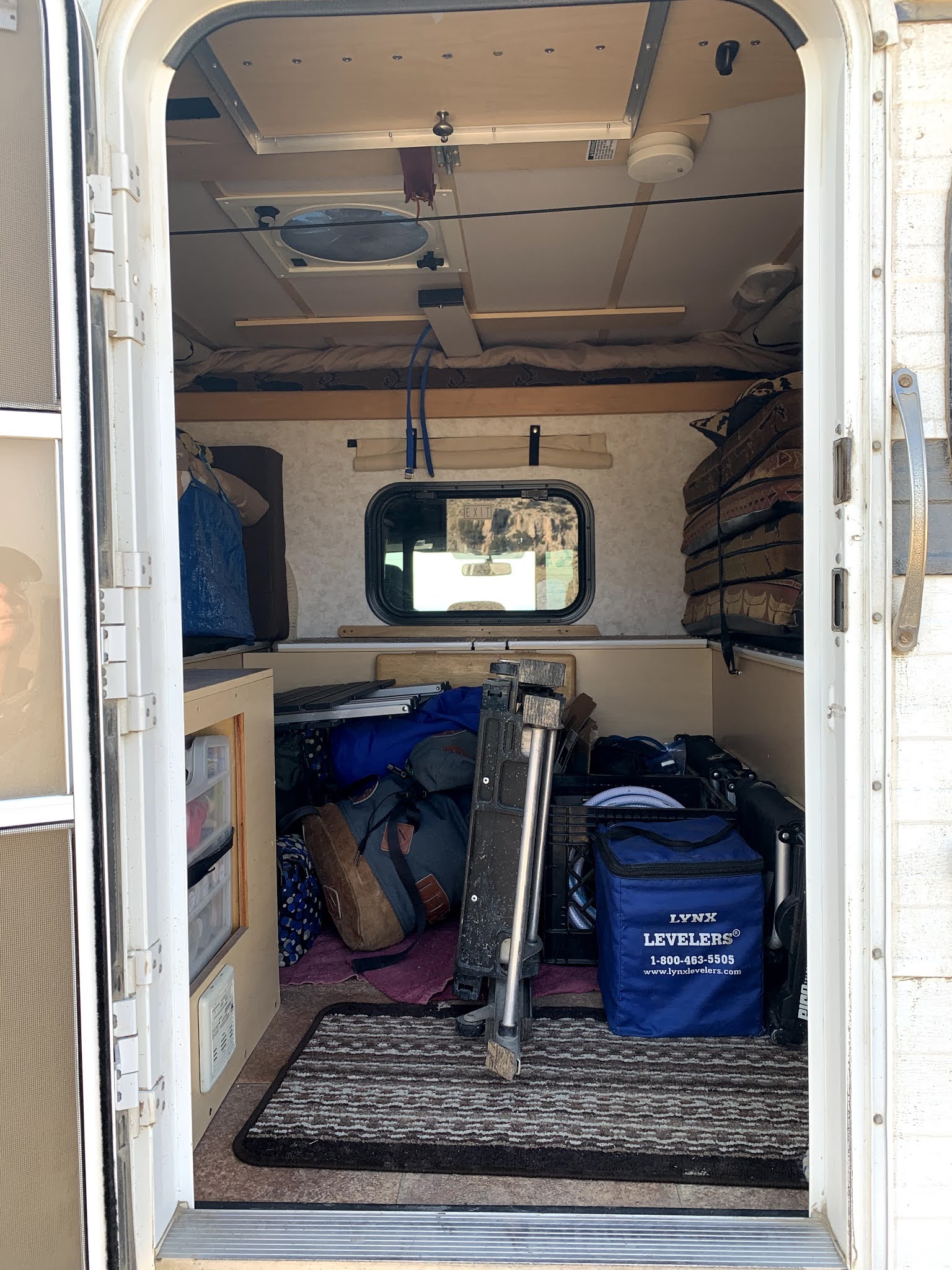
To give you an idea of how rough the roads were, here are two photos... one is how the back of the camper normally looks, and the second is how it looked after taking the rugged roads. 


We would often stop to check the second herd’s position while making our way towards them. We would scan to check them with the binoculars only to see the stallion watching us back. 


We finally crested the summit at 7,777 feet and struck out on foot. It was an arduous climb up loose rock and uneven ground. We finally reached an area where we should have been able to see the horses, only to find they had vanished. Such is the life of a photographer.


These six horses were the only ones we saw during our time here at the Challis Herd Management Area. It really was no great surprise. First, the area is vast, encompassing 167,848 acres, and we only traveled a small part of the the central portion. Secondly, and perhaps most important, the herd had suffered a helicopter round up last fall. Although this particular method is hardest on the horses, it is an expedient way to corral them and cull the herd down to recommended numbers (185 for Challis). The horses are chased by helicopter and ATVs, corralled, and culled. Often horses break legs stampeding in front of the noisy, steel beasts. We learned that nearly half the Challis herd was culled, effectively destroying the social hierarchy, band territories, and family units. It often takes over a year for herds to re-establish after such trauma. These horses were still skittish and, rightfully, leery of man. Perhaps in another year, they can rebuild their confidence and social units. Until then, finding these horses will be like finding a needle in a haystack. 


We spent our last night here under clear skies and feeling like we were the only two people on earth. How privileged we are to be here tonight.