Friday, September 4, 2020

Rugged Roads and More Wild Horses


We left Challis and decided to take an off-road loop to McCall, Idaho.  It was a rough, winding, and rocky road that took us on hairpin turns, switchbacks, and ridge-running sections so narrow that we both leaned away from the steep drop offs, praying the road's edge would hold under the weight of the truck.  The trails were so rough that we literally had to stop in the middle of the road just to take a sip of coffee. It took us three days to travel 154 miles. 

We went back through Stanley and continued on to Yellow Pine.  There were lots of fishermen, campers and ATVs along the gravel road. It was also the week before Labor Day. We had difficulty finding a camp but finally settled on a spot just north of Deer Creek Pass, across the road from Deer Creek. 


From there, the road turned extremely rough. After cresting Elk Creek summit, we camped, nestled in the valley below and next to a beautiful creek surrounded by enormous pines. It was a cold night with patches of rain. We broke camp quickly, concerned that road conditions might deteriorate. The temperature on the truck registered 38 degrees. The rain turned to snow briefly. Thankfully the rain was light until it cleared mid-day. 


Along our route, we drove through several tiny communities tucked deep in the woods that had no services such as gas or groceries.  We wondered how often they drove these roads to re-provision. We only met two oncoming vehicles on the road. The first was a pickup pulling a large horse trailer. Thankfully we were in a valley, and the road's drop off on either side wasn't too steep. But we met on a corner. David hugged the hill as closely as he could, tires nearly scrapping rock.  The other driver worked to pull around us. We weren’t certain his trailer would clear us, but it did. We all breathed a sigh of relief. We saw the second oncoming vehicle coming down the road and we’re able to pull into a gate entrance to let him by. 


We finally arrived in McCall, a beautiful resort area next to Payette Lake. The town was bustling with folks gearing up for the holiday, so we drove on. 


Our next stop was the Four Mile Wild Horse Management Area north of Emmett. We stopped in town to get directions. A wonderful lady at the Chamber of Commerce tried to help but had no information. We stayed parked in front of the building, using their WiFi to try to find the name of the road we should take. The lady came dashing out the door, waving a sheet of paper. She had found directions, complete with GPS coordinates. David quickly plugged them into our Garmin, and off we went. 


As we entered the HMA, we spied a herd of about a dozen horses high on a hill. They were too far in the distance to reach. Plus, we were exhausted from all the day’s travels. 


We found a place to camp that would give us a good vantage point for the morning. After supper, we took a stroll to stretch our legs. As we were heading back to the camper, I turned and caught a glimpse of something shiny on the mountaintop behind us. I called to David to see if he could make it out. At that very moment, I recognized that it was the moon cresting in a small saddle on the hill, radiating in silver light. We quickly grabbed cameras and watched in wonder as a full moon rose before us.  It was a breathtaking, miraculous moment.  I could only whisper, “And the skies declare His glory” (Psalm 19:1). 


Next morning, we were off in search of horses early. We found the band again, but they were still high on a hill and at a distance. A deep gully, a fence, a large creek, and a heavy uphill climb lay between us. We knew it would be an impossible climb. 


Four Mile Road is on one side of the mountain with another road running alongside the other side of the same mountain. David had a hunch we could get closer to the band on the backside. We traveled nearly fifteen miles along the gravel road, hoping to see more horses, but to no avail. 


We returned to Four Mile Road, looking for inroads. There were none that took us where we wanted to go. Finally, we returned to see if the band had moved closer to the road. To our surprise we saw a black stallion pacing along the fence, obviously wanting to be with the other band. We weren’t certain if he had somehow made it through the fence and couldn’t get back or if he was wanting to find himself a filly to steal. 


This horse was a truly magnificent animal. He watched us closely for a few moments, then crossed the road in front of us. Too soon, he was over the ridge. 


The Four Mile horses have an interesting history. They are believed to be originally from horses bred for Calvary Re-Mounts. Up until 1978, ranchers released Thoroughbred and Quarter Horse studs into the herd, culling the offspring for their own uses. As a result, these horses are recorded as having excellent size and conformation, as our black stallion certainly proved. The Four Mile herd numbers around 180 horses. 


We were disappointed to see so few horses here, particularly since the area is small. As an example, the Four Mile HMA is only 18,800 acres compared to the 167,800 acres for the Challis wild horses.  We drove up one more four-wheel drive trail, hoping to see other horses over the ridge. We only saw cattle and an ATV coming towards us. 


The gentleman driving the ATV stopped and chatted with us. He suggested we go to Murphy for wild horses. He didn’t offer much hope about getting closer to the Four Mile herd because inroads were few. After he left, David and I looked at the map. We could reach Murphy and the Black Mountain HMA by mid-afternoon. We hopped in the truck and turned south. 


Thursday, September 3, 2020

Email Posts Gone Haywire

Dear Friends Who Subscribe by Email,

The last two posts did not fully send in the last email.  Please visit the blog at http://ruffingitx3.blogspot.com to read the entire posts... and if you have time, please comment!  

Thanks and our best to all, Virginia

Wednesday, September 2, 2020

Needle in a Haystack

We drove into the Challis Wild Horse Management Area but found no horses along the entrance road. It was late afternoon, and storm clouds were moving in. We had originally planned to camp at a spot with a 360-degree view. The skies became darker and lightening struck in the high country all around us. We had to find protected ground. We decided to camp along the Salmon River but soon discovered it was privately owned land. The wind picked up, and we knew we were in for a blow. We spied a gravel pit where the county stored gravel and dirt to maintain the roads. It was perfect for us... surrounded by taller mountains and nestled below the gravel piles. Within a half hour, we were pelted by rain, rocked by wind, and surrounded by lightning. Wow!  Thankfully, the storm was short-lived, and we were soon taking a trek to survey our surroundings. 

This photo is our morning view.

We were anxious to get started the next morning, hoping to see as many wild horses as possible. David drove a steep four-wheel drive trail up to the 360-degree viewpoint. Off in the distance, I spied two sets of horses. One consisting of two horses, the other with four. Now... how to get closer!  To give you a perspective of how far away the horses were, I took the photo below with a 600mm zoom lens.  If you look closely to the left of the trees, you will see the band stallion as a white speck.

David plotted the way, and we made it fairly close to the first two horses. They were bachelor stallions. Both were curious yet skittish. We walked a distance to them before they showed signs of concern. We would stop walking, and they would stop trotting. Then they would move towards us, curious. They headed downwind of us so they could smell us.  Then they blew their noses and walked away.  We were never able to get really close to them, but it was wonderful all the same. 


The Challis horse herd is made up of a mixed DNA, beginning with Spanish mustang, American gaited horses, draft horses, and true ponies. The white stallion of these two definitely had a gaited background. When he trotted, he literally pranced.  He was poetry in motion. (If you're having trouble uploading the video, please visit my Instagram site:  Virginia Parker Staat)


We decided to try to make our way closer to the other band. It appeared to consist of a stallion, two mares, and a foal. The off-road trails were rugged, rocky, and rough. We needed every bit of our high clearance in some spots, and our heavy-duty, truck-rated E-3 tires saved the day. 


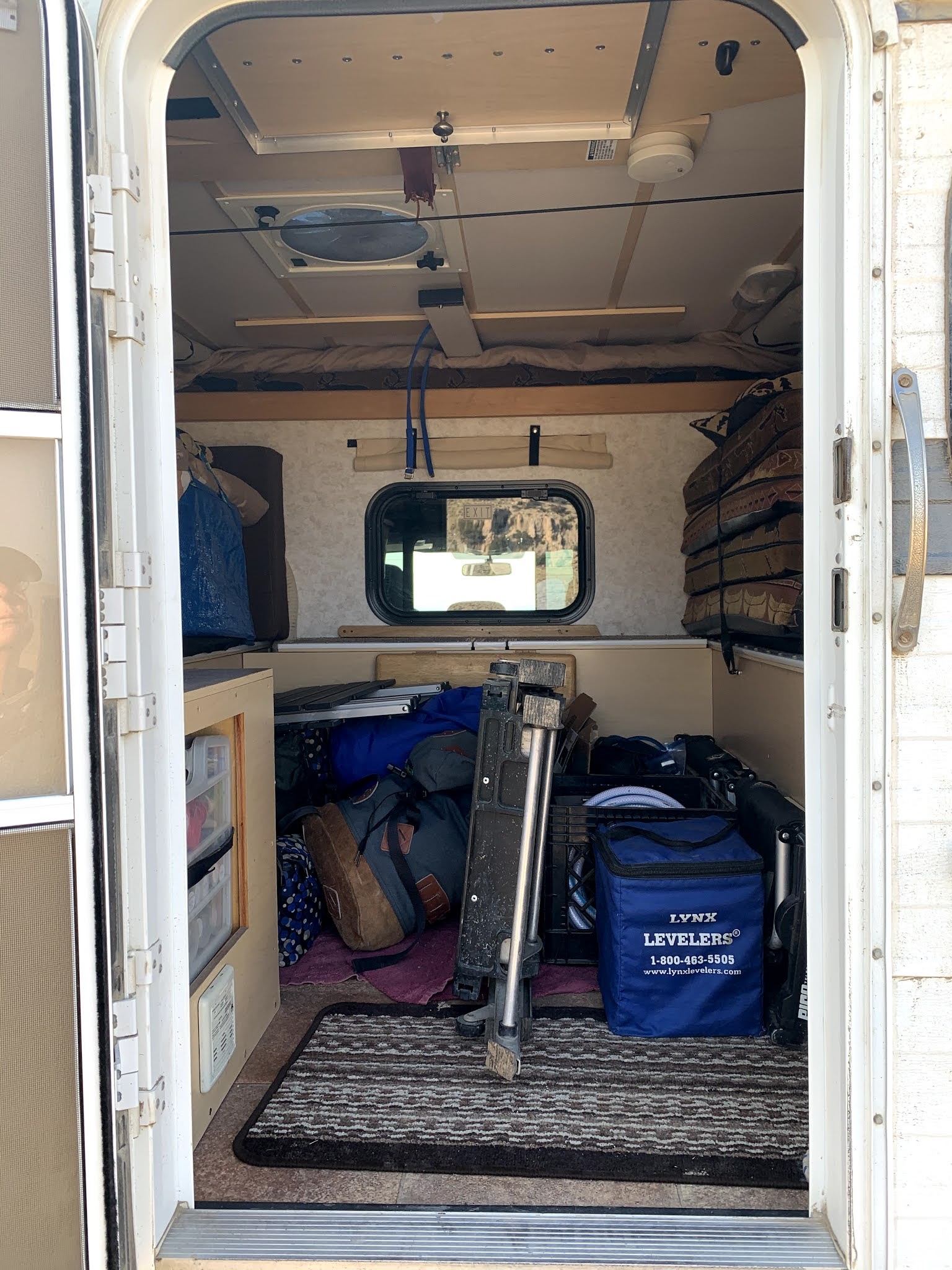
To give you an idea of how rough the roads were, here are two photos... one is how the back of the camper normally looks, and the second is how it looked after taking the rugged roads. 


We would often stop to check the second herd’s position while making our way towards them. We would scan to check them with the binoculars only to see the stallion watching us back. 


We finally crested the summit at 7,777 feet and struck out on foot. It was an arduous climb up loose rock and uneven ground. We finally reached an area where we should have been able to see the horses, only to find they had vanished. Such is the life of a photographer.


These six horses were the only ones we saw during our time here at the Challis Herd Management Area. It really was no great surprise. First, the area is vast, encompassing 167,848 acres, and we only traveled a small part of the the central portion. Secondly, and perhaps most important, the herd had suffered a helicopter round up last fall. Although this particular method is hardest on the horses, it is an expedient way to corral them and cull the herd down to recommended numbers (185 for Challis). The horses are chased by helicopter and ATVs, corralled, and culled. Often horses break legs stampeding in front of the noisy, steel beasts. We learned that nearly half the Challis herd was culled, effectively destroying the social hierarchy, band territories, and family units. It often takes over a year for herds to re-establish after such trauma. These horses were still skittish and, rightfully, leery of man. Perhaps in another year, they can rebuild their confidence and social units. Until then, finding these horses will be like finding a needle in a haystack. 


We spent our last night here under clear skies and feeling like we were the only two people on earth. How privileged we are to be here tonight. 


Idy-Idy-Idy-Ho (aka Idaho)


It’s great to be in Idaho!
  The temperature dropped into the 40s last night, with a high in the 70s. We spent our first night here north of Soda Springs, near a campground and next to a beautiful stream. That meant one thing:  showers!  Many of you may wonder how we keep clean. One way is to use our Zodi camp shower. It is a small, portable version of an on-demand hot water heater.  We also have a catch-basin system to properly drain our grey water.  We pulled water from the creek, and fired up the Zodi. It felt great! 

Next morning, David found a promising off-road trail out of Darlington. We decided to take it all the way to Lost River, then on to Sun Valley and Stanley.  My, how Stanley has changed since we were last here!  It has turned from a little country town to a bustling tourist destination. We left as soon as we gassed up the truck. 

As we entered the national forest, we passed through several herds of range cattle. It was obvious that many of the calves had never seen a vehicle before. They dashed off the road or gazed at us from under their mother’s bellies. 


The highlight of the day was seeing a bull moose in velvet. We quickly took several photos, concerned he would dash into the timber. Instead, he posed and finally laid down in the brush. Wow!  


We found a lovely spot to camp. Both evening and morning, we strolled the road, looking for more wildlife. It was chilly the next morning, and I discovered several bees on the nettles, looking almost frozen while they waited for the sun to warm them. David spied a paper wasp nest nearby, and we spent over a half hour taking photos and videos of them.


We finally broke camp and wove our way along this spectacular road. Although rugged and stoney, we only had to pop the truck into 4-wheel-drive a few times. We were definitely grateful, however, for the truck’s high clearance. Finally we reached Antelope Pass, and its 8,934-foot vista. It was absolutely stunning.  This is what we’ve been wanting!  One of our favorite phrases is from John Muir:  "The Mountains are calling, and I must go."


Too soon, we were back in civilization. We needed to resupply in Pocatello. It’s always a shock to come back to crowds and traffic, even in smaller towns. We had to pick up a few grocery items and change the oil. We also stopped by the forest service office for maps. On the off-chance, I asked if Idaho had any wild horses. To my surprise, they said yes!  I now have a general idea where three horse management areas are... now we just need to connect to WiFi and find their exact location. 


The following day we traveled a four-wheel-drive road past more beautiful scenery, on to Custer, and then to Challis.  Unfortunately, it is still too smokey for grand landscape photos.  


We were delighted to find that Challis is our kind of town... a rural, working town with lots of friendly folks and very low key. Once in Challis, we stopped by the library for WiFi to check on Hurricane Laura. Thankfully neighbours had informed us that Hurricane Laura missed us, but our hearts hurt for those in her path. 


Before we left the library, I checked for wild horse information and was shocked to find that one of the wild horse herds was right here... in Challis!  Another stop took us to the Bureau of Land Management office. Bart was able to show us exactly where the Challis horses reside. 


This trip is definitely taking a turn. We are now focusing on off-road trails and wild horses. How wonderful is that?


Monday, August 24, 2020

Wild Horses


The smoke from the wildfires surrounds us. Folks tell us that smoke from the California wildfires have made the air quality even worse. Still we press onward. 


We spent most of the day traveling gravel roads. It is a circuitous route to Spring Creek Basin from Dolores. We arrived at the wild horse management area around three in the afternoon. As soon as we entered the gates, we spied eight horses. They were extremely shy but not as skittish as they were during our last visit. The horses looked better than I expected, considering the drought and limited vegetation.


The Spring Creek herd consists of about 80 horses. The area where they reside is vast and much of it inaccessible by vehicle. We drove deep into the hills but turned around when the road became nearly impassable. We decided to drive down another road that seemed to lead to a greener area. As the road neared its end, I spied several horse heads peeking above the foliage. David backed up, and sure enough, we spied a half dozen or more horses in a draw, nearly 50 yards from us. 


We abandoned the truck and hiked towards the horses. All were at attention, ears perked in our direction. The horse trail we were following appeared to block the horses. Not wanting to spook them, we climbed to the top of the draw, overlooking the horses. They seemed curious but not frightened of our presence. The horses were gathered around a small spring. They would paw the ground, making an indentation that would fill with water so they could drink. As with most wild horses, they took turns drinking.  David counted 18 horses, including foals. While we watched, the first group took to the hills above the draw and opposite us. 


I love observing animals in their natural habitat. After about a half hour, we left the horses to make our way to our camp spot for the night. It was the same one we had used during our first visit and not far from the original eight horses we met earlier. As we connected with the main road, we saw the horses from the watering hole galloping towards us. We stopped the truck and watched them meet up with the other group of horses. After a few minutes, they all began to graze. We left them to set up camp. 


About an hour later, the entire group meandered up the road near our camp. We sat still, hoping they would come closer. No such luck... they took off, splitting into two bands and hightailing it across the plains. A group of five bachelor stallions moseyed behind, taking their time. 


Although the temperature was well in the 90s when we arrived, it began to cool down as the sun set a deep red because of the fires. We had a pleasant night’s sleep. Alas, as we left the basin, the horses were so far in the distance, we could barely make them out in the smoke-filled horizon. 


We left rather early in the morning, hoping to make the Sandwash Basin herd by afternoon. We decided to stop by the visitor centre in Fruita to make certain the way was clear. It was a good thing we did. Our preferred route was closed because of a wildfire. Crews were hoping to use the road as a break to prevent the fire from jumping. So we backtracked to Grand Junction and took I-70 to Highway 13 and on toward Maybell. 


We arrived at Sandwash late afternoon and set up camp on the bluff, overlooking the river. The next morning, we were in the truck early, anxious to find horses.  We tried a different route into the horse management area and soon spied horses. Most were uncooperative, but we found a small band that seemed approachable. As we took photos, a second stallion moved in. We thought there might be some action between the two stallions, but the one leading the band simply turned his rump to the other. Each of their ears cocked and laid flat against their heads, then cocked forward, then back again, but nothing more. When the colt laid down, he seemed to be telling us that this waiting game could go on forever.  We decided to move along. Soon the road became impassable, so we turned around. When we drove by the band again, the two stallions were exactly where we left them. 


Later we spied four bachelor stallions leaving a watering hole. We parked the truck to take a few photos. One of the stallions looked very old and was covered with scars. 


Two new horses came trotting our way. When they were close to the watering hole, they fairly bolted to the water. We watched from a distance to give them their space. There is so little water out here, particularly with the drought. We didn’t want to disturb their drinking. 


We found two other watering holes, both completely dry. The sun was bearing down, and the temperatures soaring once again into the 90s. Cold weather awaits us in Idaho. We made a unanimous decision to leave the smoke and heat and head for higher ground. Hopefully we will have one more wild horse herd to visit before we head for home.  This last photo is our morning sunrise.


Saturday, August 22, 2020

On the Road Again

Sunset over Caprock Canyon

It feels great to be headed west today. Our first stop was Caprock Canyon State Park near Canyon, Texas. Known for its painted hills and wild bison herd, Caprock has become our launching point for many of our trips. We arrived after the park closed and found our reserved site was a walk-in... hardly conducive to our rig. No worries. We camped in our favourite spot, the overflow area. We watched a glorious sunset and enjoyed a cooling breeze. By morning the temperature was in the low sixties. 

As we left the park, we found a portion of the wild bison meandering on the road. We spied several bathed in red dirt and early morning light. 


My navigator David is working overtime this trip. We can’t travel our normal route through New Mexico because the state is under a mandatory 14-day quarantine if we even cross the border or travel through in a single day. The western portion of Colorado is plagued with wildfires. We have chosen a route just north of New Mexico, along the southern edge of Colorado.  Thankfully, the folks at the visitor centre in Trinidad told us the area is free of wildfires. 


Our first several days of travel are always long. It was near 6:30 when we settled into our first campsite in Colorado along the Highway of Legends. We found a dispersed campsite near Cochura at over 10,000 feet in altitude.  The site was along a creek and high in the mountains, surrounded by deep forest. The best part was it was cool enough to don sweatshirts... something we have been longing to do for months. These are the times, however, when being a flatlander has extreme disadvantages.  After we huffed and puffed up the road a short distance, we were in bed by 7:30 between the high altitude and time change. 


We awoke from an eleven-hour sleep refreshed and ready to roll. We took Forest Road 250, a gravel road that runs along the Rio Grande National Forest and the eastern side of the South San Juan Wilderness area. It was an easy day of travel. Tonight we camp in the valley and at the base of  Big Red and Little Red mountains. The view is spectacular. 


Big Red and Little Red Mountains


Tomorrow we hope to head west on 160 through Pagosa Springs and Durango, then turn north of Delores and on to visit old friends... the Spring Creek Basin wild horse herd from our 2016 trip. Hopefully we will still be south of the fires and able to access the BLM land where they reside. We may not see bears this year, but I have my heart set on photographing wild horses. 


Tuesday, August 11, 2020

It's Been Too Long!

Dear Friends, It has been much too long since I've posted. What a year it has been for everyone! We do hope this finds each of you well. 

As for us, our Australia trip ended abruptly last summer when David's mother had a massive stroke. We flew home and spent as much time with her as we could during the next two months. She passed away at the end of September, 2019. Soon after that, David had rotator cuff surgery. He was well on the mend when I was invited to present my new book, The Legend of El Patron: A True Story, at the Tucson Festival of Books and the Texas Library Association conference. Halfway to Tucson, we received word that the festival was cancelled because of the pandemic.  The following week, the Texas Library Association conference also cancelled. I can only imagine your personal stories and how they may be even more dramatic than ours. 

After a bit of a shaky start, Texas is opening up from the lockdown quite well. David and I have been waiting most of the summer to see if Canada will open its borders also.  We so wanted to return to Alaska!  Unfortunately, Canada remains closed.  Not to be deterred, however, we plan to take a trip in our camper to enjoy the wilderness... somewhere.  My, how we have missed it! So we will head towards Idaho and, perhaps, retrace some of the wild horse ranges in Colorado and Utah. Of course, much of this all depends on how various states are open to travelers. 

The housesitter is ready to arrive this weekend. Our hope is to leave either Sunday or Monday. We invite each of you to join us on our somewhat scaled back adventure this year. Who knows what we might find? 

 Blessings to all. 

 P.S.  If you'd like more information about the outlaw Texas bear El Patron in my children's book The Legend of El Patron:  A True Story, you can find it at Amazon (https://www.amazon.com/Legend-Patron-Virginia-Parker-Staat/dp/1644384922) or on my website virginiastaat.com. Also, you can view the book's trailer here:  Legend of El Patron book trailer. Thanks for your interest!