Friday, September 16, 2011

The Heavens Declare His Glory

This post title is from Psalm 19:

The heavens declare the Glory of God
The skies proclaim the work of His Hands.

The story of our experience with the Northern Lights is really quite funny.  If you read our Dempster post, you know that we saw a pale green beam over our campsite in Inuvik and were delighted to know that it was the Northern Lights.

Until Eagle Plains... when our new-found Swiss friends showed us fantastic photos of Northern Lights that they had seen the night before.  David and I had slept right through them.

Two nights later, a gentleman in the campsite next to us at Tombstone offered his photos of the aurora borealis that he had captured the night before... again, David and I had slept right through them.

The morning after our first night in Muncho Lake, a delightful Swedish couple told us about their seeing the Northern Lights.  The following night, another camper told us about his experience and that he had seen them about 10:30.  We set the alarm but saw nothing.

Each night, if one of us woke up, we would peer into the night sky to no avail.  We figured that with our sleeping patterns we were simply destined not to see the Northern Lights.  That is, until Wood Buffalo...

On our first night at Little Buffalo River Campground, I got up around 2:30 and peered out the camper window.  As most of you know, I can't see diddily without glasses, however, I can certainly distinguish light and color... and I saw green lights dancing across the sky.  I grabbed my glasses and woke David.

We climbed out of the camper, gazing up at brilliant skies.  Although the temperatures had dipped into the thirties, we were so amazed that we hardly noticed the chill.  The skies had become alive with Northern Lights.

It is impossible to explain them in words.  The closest I can come is that they were like crazy, out-of-control rainbows.  They arched across the sky, dancing and shimmering, swirling and twirling.  They would ebb and flow in shades of brightness.  Some times there were two bands, others only a bright beam shooting over the full moon and shimmering stars.

I can only offer these two-dimensional photos as a feeble attempt to explain the moment.


And how do I explain the feelings that we shared?  It was as if we were the only two people on earth (truth is, we probably were at least the only two people within a thirty mile radius!).

We stood like children, dressed in our pajamas, amazed and awed at this incredible sight.  Tears burned my eyes.  We told each other that this was enough... to be blessed so completely was more than we could have ever asked for and almost more than we could stand.  The words to an old song bubbled to the surface, and we began to sing...

Why me Lord, what have I ever done
To deserve even one
Of the pleasures I've known?
Tell me Lord, what did I ever do
That was worth love by You
Or the kindness You've shown?
(Why Me, Lord?  by Kris Kristofferson)

Thank You and bless You, our Amazing God!

Thursday, September 15, 2011

The Liard Trail

Our trip up the Liard Trail was dusty but uneventful.  The word liard means "poplar" in French.  The road was aptly named, fringed on either side with beautiful, golden poplar trees.

The road is over 400 miles in length and offers a substantial short cut between Fort Nelson and the road to Yellow Knife.  Making certain that we had adequate gasoline was our biggest challenge.

We did see some wildlife, including several black bears and this very busy beaver.


We stayed at two wonderful Territorial Parks:  Blackstone River and Sambaa Deh.  We were extremely pleased that the Sambaa Deh campground had hot showers.

Most of the parks in the Northwest Territory have closed or are closing by September 15.  We are feeling the pressure and are currently just one step ahead of the closing date.   Hopefully we will be able to find places to stay before heading back to Jasper.

After hearing that the frost heaves on the road to Yellow Knife were rather arduous, we decided to skip that portion of the highway and head straight to Wood Buffalo National Park.  This park has particular attraction for me... it is home to the endangered whooping crane.

I grew up just a stone's throw from the whooper's wintering grounds.  Wood Buffalo National Park will be another "full circle" moment.  We can't wait!

Monday, September 12, 2011

Muncho Lake

The highway from Klondike Corner to Whitehorse was shimmering in gold.  Low on provisions and needing a bath and laundry, we decided to stop over in Whitehorse again to clean up and restock.  We were now back on the the Alaskan Highway and spent much of the day reminiscing last year's adventure on this same road.

The following evening, we spent the night at the Rancheria campground, relishing a hot breakfast at the motel's restaurant the next morning.  The owners told us that they were hosting a large convoy of 200, complete with some of the original vehicles, next August in commemoration of the building of the Alaska Highway.  Sounds like fun!

Our next destination would be Muncho Lake, one of our favorite spots on the Alcan.  We had seen many large animals on this section of the highway and were anxious to see what it had in store this trip.  Soon we were seeing herds and individual wood bison along the roadside.
Wood bison near Muncho Lake
About 30 miles from Muncho, we spied a group of Stone sheep, licking minerals on the road.  It is amazing to see how close vehicles come to these critters.  They barely move, even when a semi speeds close to them, blowing his horn.  Most of drivers slow down when they see animals on the road, but not all.
Stone sheep along Alaskan Highay


Happy to finally have some large animal photos, we traveled on to Muncho Lake.  We arrived at the Muncho Lake Provincial Park and set up camp.  Rox was absolutely delighted to be out and swimming again after being stuck in the truck for several days.

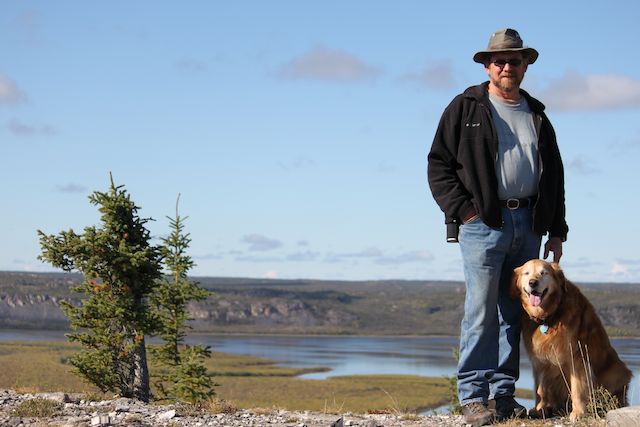
Dave & Rox at our Muncho Lake camp.


Our campground was very near the Northern Rockies Lodge, one of our favorite (albeit very expensive) spots.  The lodge is lovely and set against some spectacular scenery.  They also have some of the best spaetzle in their restaurant.  The owner offers float plane flights to his guests for sight seeing and overnight stays at fishing lodges across the lake.  One day we hope to take one of these side trips.


The next morning, we were anxious to see if we could find any animals to photograph.  We were delighted to finally find caribou and some beautiful scenery.


We stayed at Muncho Lake for three wonderful nights, basking in its beauty and wonderful sunshine.  As the sun continued to shine on us we wondered... should we head for Jasper or further east?  The Liard Trail and Wood Buffalo National Park beckoned but we were concerned that it may be too late in the season to attempt the trip.

Beautiful Muncho Lake
We spoke with our campground host that evening about the Liard.  She told us that the young couple in Site 6 lived in Yellowknife and would know first hand.  We talked with them after we broke camp the next morning.  It had frozen the night before, and the young helicopter repairman spoke with us dressed in a T-shirt and jeans... while we were in three layers.  He assured us that the road was good, and we had heard that the weather would hold.

The choice was easy.  We stocked up on a few more supplies in Fort Nelson and left for the Liard Trail.  Another adventure awaits us!

Wednesday, September 7, 2011

The Dempster’s Coat of Many Colors (Part Two)


It was now Friday, the beginning of Canada’s big Labor Day holiday.  With many establishments in Inuvik shutting down for the entire weekend, we decided to travel south. 

We were also concerned about finding an open campsite.  We had learned last year that most of Canada shuts down over this weekend.  The holiday is particularly important because it is the final weekend before the children return to school.  The tempo of the entire country seems to change after this date.  Labor Day signals a change in seasons.  Campgrounds begin shutting down and the tourist season wanes.

We traveled back across the Mackensie Delta.  This entire section of the Dempster, from the Mackensie River crossing to Inuvik is a vast, flat land.  It is covered in boreal forests with trees rarely taller than a man because of the permafrost.  Additionally, over fifty percent of the area is considered wetlands.

David and Rox on the Mackensie Delta
We passed an section of road with over a dozen snowshoe hares and another with Ptarmagin.  Both were beginning to turn white from their feet up to their bellies.  We saw a large black bear foraging for berries along the roadside.  He was a bit jittery when David pulled over and shut off the truck’s engine.  However, he soon determined that we were no threat and continued eating his snack. 


We stopped for some time at our favorite vista near the Yukon-Northwest Territories border.  David scanned the open tundra for signs of caribou but found none.  Last year, this same spot had been filled with hundreds of caribou.  We had thought that we had missed the migration last year, when, in fact, we had actually observed it.  This section of the Dempster is the Porcupine Herd’s wintering grounds and their ultimate destination most winters… but not this one.

We camped at Rock River Campground that night, hopeful that we would see more animals if we left early the next morning.  We were camped along the river when a Swiss couple asked if they could walk through our site to access the water.  We chatted for a few moments before they left for their stroll.

While we did not see caribou, we were delighted to find a bull moose crossing the tundra during our morning drive.  We and another couple were blessed to watch this magnificent beast until the driver of a big rig popped his air brakes and scared the moose into the forest. 


North of the Arctic Circle where we had seen last year’s grizzly close up, we saw a magnificent silver/grey bear in the far distance.  He would dash across the tundra, then whirl around, seemingly simply enjoying the moment.  We watched him for some time before he disappeared into the creek bed, wondering if he was the same bear we saw up close in this area last year.


At Eagle Plains, we met the Swiss couple again while we were all seated in the lounge area, trying to catch up on emails in the only area with internet access.  Carol and Rox became fast friends while Andi, David, and I became better acquainted.  The two are from a large city in Switzerland and have come to the Yukon several times.  Like us, they have been smitten by its beauty and remoteness.

As we drove along Olgivie Ridge toward Tombstone the next morning, David and I saw a large animal crossing the road about 25 yards ahead.  Obviously a large cat, it was buckskin in color and had a long body and tail.  It was so large that its front paws hit one set of tire tracks along the road, while its back paws hit the alternate set of tracks.  We both knew immediately that it was a mountain lion.  There was no time to snap a photo, however, we felt truly blessed to have seen one of these elusive creatures!


Olgivie Ridge, overlooking Continental Divide
Near where we saw the black grizzly on the way to Inuvik, we saw a mother grizzly with twin cubs foraging.  While again too far in the distance to take great photos, it was fun to sit and watch the trio.  The little ones appeared to be this spring’s cubs, one black and the other a cinnamon-grey.

Mother brown bear and twins
We remained optimistic about seeing more caribou.  Many along the route told us that where you see grizzlies, you will most likely see caribou this time of year.  This area is a natural passageway for caribou and the open terrain affords ample hunting opportunity for both man and beast.

Past Engineer Creek campground, we hit a section of talus and spied a large cross fox hunting among the rocks.  The fox ran across the road, only to discover that his hunting had led him between the river and hill, with only the road in between.  Feeling trapped, he didn’t know where to go.  I took just a few photos before we drove on, leaving him ample space to retreat.


Cross fox
As we drew closer to Tombstone, the clouds became heavy, and it began to mist.  By the time we reached North Fork Pass, it began to snow.  While the weather had been almost warm in Inuvik, the Tombstone Range sported a fresh dusting of snow all around. 

We camped in one of the few remaining sites along the river.  With all the rain, the campground was extremely muddy.  Crawling into the back of the Xterra, we worked hard to keep all of us from tracking mud on the bedding.

It rained and sleeted most of the night.  By morning, however, we were basking in sunlight.  We bundled in more layers, well aware that the temperature had dipped below freezing.  Sheets of ice slid from our neighbor's tent.


We weren’t sure how we would be able to keep Rox from being caked in mud if we let her out of the truck.  In a brilliant moment, however, we decided to drive up to the Tombstone Valley overlook to catch the early morning light for photos.  As a bonus, the overlook is heavily graveled, making it a perfect spot to let Rox out. 

While David made coffee off the back of the Xterra, I took photos.  The valley was at its peak of autumn colors and absolutely breathtaking!  This moment was one I will always treasure.  The Dempster holds its coat of many colors for such a short time, rarely a full week.  Already we could see the reds were turning to rust.  We felt tremendously blessed to witness this spectacular scene.


Tombstone Valley, Dempster Highway
Late that morning, we drove back to Klondike Corner to retrieve Oz.  We filled up with gasoline and returned to Tombstone.  For the next two days, we savored the Dempster. 

We drove back towards Engineer Creek to try to photograph more of the colors.  The mountains almost seemed as if they breathed.  The aspen and poplar golds draped the mountains, weaving a tapestry with the deep greens of spruce and rich veins of reds with clusters of orange alders.  We felt drenched in its beauty.


Wildlife experts at the visitor’s center were excited to hear about our mountain lion sighting, a rarity in these parts.  However, because we didn’t have a photo, the sighting remains unconfirmed.  We filled out a special animal sighting form for their files.  They will log our list of other animal sightings to help compile records on the movement of animals along the Dempster.

On our last full day, we hiked the Goldensides trail.  Thankful that we had dressed in multiple layers of our heaviest coats and rain gear, we braved the sleet for one last look at Tombstone Valley.  It snowed at the peak.  

Us on the Goldensides Trail
By evening, it was clear enough to hike the Interpretive Trail near the campground and photograph the lichen and the forest floor littered in gold.


Lichen field


Our new Swiss friends joined us at our campfire each evening.  They confided that they had made the decision to try to immigrate to the Yukon.  Our prayers and best wishes remain with Andi and Carol.

As for David and I, we, too, hope to return to the Dempster soon.  It now holds an even more special place in our hearts.  Last year, the Dempster was an adventure and destination to reach.  This year, we feel as if we know it so much more intimately.  We have grown to love its people.  We have seen the diversity of its magnificent animals.  We have witnessed some of its mysteries.  We have truly relished its coat of many colors.

The Bible tells us of a coat of many colors.  Jacob gave his youngest son, Joseph, the beautiful coat as a special blessing to this beloved son.  As we leave the Dempster for a second time, we feel that God has most certainly given this portion of His world a special blessing.  And we know that we have also received a special blessing just for having witnessed it. 

The Dempster and Its Coat of Many Colors (Part One)


On Sunday, August 28, we camped at Mile Zero on the Dempster Highway at the Klondike River Lodge, awaking to a very brisk 36 degrees inside the tent.  The beautiful and much-welcomed sunshine soon burned off the fog, leaving us with a perfect day for our return to the Dempster Highway.


With there being only three service stations on the Dempster, we opted to leave Oz at the Klondike corner to conserve gasoline.  Except for a stop at Eagle Plains in both directions, we planned to sleep inside the Xterra while on the Dempster.

When we reached the Tombstone Valley overlook, gray clouds hovered above.  We saw immediately, however, that we were just days ahead of peak colors.  Excited that we may actually hit the valley during autumn’s peak, we determined to go on to Inuvik, figuring they would be at least a week earlier in their coat of many colors.

On our way to the Engineer Creek campground, we spied a small herd of white Dall sheep along the eroded sides of the Olgivie Mountains.   This was our first sighting ever of sheep along the Dempster.

Dall sheep on the Dempster
That evening, we camped at Engineer Creek Campground, last year’s campsite where we saw the silver-banded wolf.  There was so much noise in the campground, however, that he did not appear.  It was a long shot, but certainly would have been a welcomed one!

The next morning, we broke camp early hoping to catch more animal sightings.  We stopped at Elephant Rock, a unique rock configuration on the Dempster, to make coffee.  David caught sight of a bull caribou on the road.  I was only able to pop one rather poor photo before he disappeared into the bush. 

Elephant Rock
Later that day, we spied a black grizzly, grazing berries on the Eagle Plain plateau, along its alpine tundra slopes.  Although he was several hundred yards away, we managed to take a few photos.  He looked fat and healthy and in no distress over the upcoming long winter’s nap.


That evening, we stayed at our favorite oasis, the motel at Eagle Plains.  Eagle Plains was built during the construction of the Dempster Highway as the mid-way point for weary travelers.  It is the first gasoline stop available since leaving the Klondike Loop, some 269 miles to the south.  In addition to a small service station and garage, the motel has 32 rooms and a restaurant. 

It was great to take a shower and settle into our room, which overlooked the west.  It was after ten that evening when I looked out our window.  I called to David that we had to go outside… we were about to have a spectacular sunset.  Within moments, the Dempster’s coat of many colors turned red.

Sunset at Eagle Plains
The next morning, we were off to the Arctic Circle.  Unfortunately, it was raining again.  The mud began to accumulate on the running boards and bumper.  Rox had to do her magic tricks to keep from bringing mud inside the truck. 

Keeping out of the mud
Later that morning, the clouds began to clear.  Again, the Dempster showed the reds.  At the Olgivie-Peel viewpoint, we snapped a few more photos.  By the time we reached the Yukon-Northwest Territories border, however, the fog was so thick that we could only see several car lengths in front of us.

We arrived early afternoon in Fort McPherson and stopped by last year’s campground, hoping it was still open for the season.  We immediately recognized the gentleman who was running the campground from last year.  He had been such a hoot that we were both anxious to give him our regards.

He got out of his truck and rubbed the mud off our license plate with his finger to see where we were from.  “The Lone Star State?”  He said. “How’d ya end up here?

David joked, “We’re lost.”

“You’re in the Arctic, you know,” he replied.

David told him that it was over 100 degrees in Texas. 

The man replied, “Well, that’s a good enough reason to be here.”

Then David told him that we came back this year, hoping that the campground wasn’t closed and explained that we were his last campers last year.  In fact, we set up at our site not knowing the campground was already closed. 

He replied dryly, “Well, you’re a little earlier.  We close in five hours.”

He invited us into the small Gwich'in museum and visitor's center in front of the campground.  We signed the guest register and talked about the caribou.  He said that a herd had come through several weeks earlier and none since.  They had even taken a different path than usual.

Although he invited us to stay, there were issues with the bathhouse.  Also, it was early, around two in the afternoon, so we decided to travel on to Inuvik. 

The ferry crossing across the Mackensie River took longer than usual, so we arrived in Inuvik near seven in the evening.  We set up camp in our favorite Jak campground, only to learn that they, also, were closing the next day and we would have to move.   
Mackensie River Ferry
That night, David awakened me to look at the night sky.  We crawled out of the Xterra, huddled together in the night chill.  For the first time, both of us witnessed the Northern Lights.  Although they were extremely pale, it was an awesome sight and one that will draw us back to Inuvik.

We spent two days in Inuvik, visiting familiar places, including our favorite Café Gallery.  On a hike near Lake Beloit, we spied a pair of Peregrine falcons flying overhead.  These amazing birds migrate over 15,000 miles each year, traveling as far south as Mexico.

Beloit Lake
The next evening, we camped at the Gwich'in Territorial Campground,
nearly 25 miles south of Inuvik.  Fred, a First Nation gentleman invited us to visit his site and a typical Gwich'in tent.  He explained that he was showing teachers in the area some of the old ways. 

We have always found the Gwich’in people to be extremely friendly and hospitable.  Fred was no exception.  He talked with us about the class that he was conducting.  He lamented that all of the elders were dying and that his community was losing their culture.  He said that everything seemed to be changing, including the weather.  While it felt warmer this year, the berries were ripening a full month later than usual. 

Later we spoke with one of the teachers who seemed to discount the entire affair, telling us that Fred was conducting a required “cultural sensitivity” class for the entire school staff.  The words rankled me… why not “cultural appreciation?”  It seemed to confirm Fred’s comments that the old ways were, in fact, dying.  It is a loss for both the First Nation peoples and us.

For more information about the Gwich'in culture, please click here:  http://www.gwichin.ca/TheGwichin/Gwichin.html

Saturday, August 27, 2011

Sunshine on the Silver Trail

We reached our fourteenth day of consecutive rain.  Our first evening on the Silver Trail, however, the sun finally broke through the heavy clouds.  We relished the blue skies and thought of our dear friends in Texas who have prayed for fourteen consecutive days of rain.  Oh, how we (and everyone that we speak with up here) would like to send this rain and cold to you all!

Concerned that we may be a bit early for full fall color on the Dempster, we decided to take a detour up the Silver Trail.  The road begins at Stewart’s Crossing, and runs from Mayo up to the town of Keno.  Over half of the 64-mile road is unpaved.

We camped at the Five Mile Lake Yukon government campground, away from the lake to keep the Golden dry.  With so much rain, Rox’s coat takes nearly the entire day to completely dry.

Early the next morning, we were up early to hunt for moose.  On a 12-mile four-wheel trail up to Minto Lake, we saw tracks, but no moose.  The only creature we could find was a ruffled grouse, ruffling.  I stalked him with the camera for about 50 feet before he finally ducked into the brush.


We decided to take the loop to Keno, not recognizing that the seldom-used back half was for 4x4s only.  The road had several water crossings, but otherwise was in fairly good shape.

Keno is an old mining town with lots of history, dating from 1906 when silver lead veins were discovered.  Today, Keno is a mere shadow of its former self.  However, with the price of gold rising, several mines have recently been reopened.  We checked out their town museum before chatting with the lady at the Keno Visitor’s Center.

We have not seen a hoofed animal in nearly a month… no moose, elk, caribou, or even deer.  It has been a huge disappointment after last year’s abundant sightings.  We learned from her that hunting season in Canada begins the first of August.  With hunting being huge in these parts, obviously, all the hoofed animals have hunkered down somewhere, trying to stay as far from humans as possible.  In order to see them, we now know that we must head towards wildlife preserves and national parks.

We drove up to Keno Hill to the signpost, meeting a miner and his family out for a drive.  He told us that a friend of his witnessed a herd of caribou migrating on the Dempster.  He said that some times the herd will move in two sections, with the weak and old leading the migration several weeks prior to the main herd.  Our hopes are high that we will catch the second migration.

Keno Hill reaches an elevation of 6,065 feet, offering panoramic views.  We hiked up to the ridge, then back down to the signpost.  A group of lady geologists arrived shortly after we did.  One was raised in Houston, so we immediately struck up a conversation.


That evening, our camp was invaded by moochers, looking for handouts.  These brazen jays swooped down, inching surprisingly close, much to the chagrin of Roxanne.

David discussing the detriments of poor diet habits with one of our  camp hosts.

Tomorrow we break camp and head for Dawson City to stage for our trip up the Dempster.  With rainbows leading the way once again this year, we know for certain that life is good!  :)


Wednesday, August 24, 2011

Haines, Alaska


Rain continues to follow us.  With forecasts of continued rain in any direction that we travel, we opted for Haines.  Haines is another port site on the Alaskan Marine Highway, so we had no idea what to expect.  Last year, the town of Skagway was replete with cruise ships and tourists.  It seemed almost scary busy after weeks of being out in the bush.  And, well, you already know about our Hyder experience.

Since it appears that we are at least a week too early for the Dempster, Haines beckoned, particularly with the promise of an eagle sanctuary and a possibility of viewing bears fishing the weir along Chilkat River.

We made Haines Junction by mid-day and determined to camp at the Million Dollar Falls Yukon government camp.  The site was extremely remote, so we tested out the electric bear fence for the first time.  It was a hoot just watching David with instructions in hand, setting up our “home security” system.

David awakened in the middle of the night, feeling sure that some hooved animals breached the fence.  Rox and I slept through the whole thing.

The next morning, we drove through alpine tundra and sharp mountains, all mysteriously cloaked in a misty fog.  In areas along the highest summits, visibility dropped to only several car lengths.  We stopped for road repairs and several pilot car escorts before arriving at US customs. 

How wonderful it was to be back in the States again!  We quickly realized that we not only had cell service but also no roaming fees.  We set up outside the visitor’s center and called to see how David’s brother is doing.  Paul is in the middle of his second round of cancer treatment.  We were delighted to learn that he would be released from the hospital within a few days. 

Unfortunately, Internet service was impossible to come by in Haines, so we’re waiting to upload this post.  It seems that we either have cell or Internet service or neither on this trip. 

We camped at a remote state park called Chilkat; a beautiful park nestled among tight groves of aspens.  The campground host told us that while they had moose, the Chilkoot Lake State Park on the other side of town had bears.  He recommended that we visit and told us that every time he had gone, he had seen bears.

Our first visit offered no bears, just busloads of tourists from the cruise ship.  We learned that unlike Skagway, Haines only had cruise ships docking on Wednesdays.  Just our luck that we arrived on a Tuesday evening!

We returned to our campground and decided to drive down to the boat launch, just in case any moose were hanging around, wanting to be photographed.  While there were no moose, we spied a bald eagle hopping around the shoreline at some distance.  It seemed as if he were dancing a bit of a jig, then he would disappear behind some marsh grasses before he jumped again.

David watched the eagle through his binoculars, while I watched through the big lens.  Suddenly, the eagle took off, barely skimming the water.  I started shooting.  While the results are less than stellar, it is easy to see that he had been beheading a large fish on the shoreline.  He landed on the pillar and called to his sweetheart.  They soon flew off together and enjoyed their evening supper in a nest of pine branches.


After a trip back to the weir the next morning to see bears (again with no luck), we found a Laundromat with great showers the next day and did some much-needed “freshening.”  A trip up to the eagle sanctuary offered a few photo ops amidst intermittent rain, but nothing spectacular.  We did speak with a lovely young woman from Ontario who had just come down from the Dempster.  She said that in about five days, we should hit peak color.  We were excited at the prospect.

That evening, we decided to take one more waltz down to the Chilkoot weir.  We immediately spied “Speedy and the twins,” a mother bear with year-old twin cubs.  We watched them across the river for some time before they disappeared.  David and I decided to set up by the weir, just in case Speedy tried there next.  I set up near some professional photographers who were funny and kind and helpful.

Soon, “Mama and the triplets” arrived at the weir.  Her cubs were over a year old, so Mama rested under a grove of trees while the trips fished.  It was fascinating to watch them.


After a time, Speedy and the twins arrived on the opposite bank, about fifty feet from us.  We were mesmerized, watching them fish.  Then another busload of tourists arrived. 


I was at the edge of the riverbank, just above a steep drop off, leaning against a pine and shooting photos.  The tourists began crowding around us.  One jumped down next to me, using my shoulder as his anchor, nearly pushing me into the river in the process.  I hurled around, trying to find solid ground, looking for David.  The man apologized and said that everything was fine.  Not so for me.  There were too many people crowding around me.  I was ever so grateful to find David’s hand reaching for me.  He pulled me up to the road.

About that time, Speedy had brought her salmon in the middle of the road to feast on it.  Some tourists in a van decided that they had to drive right past her, startling the bear.  As most of you know, it is simply not good manners to get between a mother bear with cubs. 

All of us began backing up as Speedy and the twins made their way towards us.  The bears quickly detoured into the adjoining woods, leaving us all upset at these inconsiderate people.  Richard, one of the professional photographers, lamented that Haines had become such a tourist trap.

The next morning, we broke camp and left Haines.  On our way out, we stopped by the now familiar eagle sanctuary’s viewing platform.  To our amazement, an enormous brown boar was fishing for salmon.  He was across the river and some 200 yards away.  We had never seen a bear so large.  I leave you with some photos of this absolutely magnificent beast.